
Identifying the Hidden Problem
When facility managers upgrade their Outdoor Lighting, the Request for Proposal (RFP) almost always focuses on one number: “Lux.” The assumption is simple: “If I install brighter lights, my parking lot will be safer.”
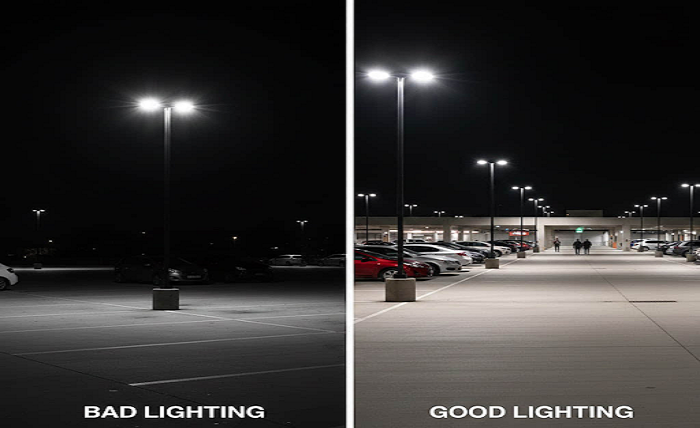
However, this is a dangerous misconception. You can install a 30,000-lumen fixture, but if that light is concentrated in a tight circle directly under the pole, you haven’t created safety; you’ve created a “zebra crossing” of blinding hot spots and pitch-black shadows. The real metric that defines safety is not brightness—it is uniformity.
Defining the Standard (What is Uniformity?)
So, what are Parking lot lighting uniformity standards?
According to the IESNA (Illuminating Engineering Society) RP-20 guidelines, uniformity is measured as the ratio of the maximum light level to the minimum light level (Max:Min).
The Standard: For a typical commercial parking lot, the ratio should be roughly 15:1 or better. For high-security zones, it should be 10:1.
The problem with generic Area Lighting fixtures is that they often use standard 60° or 90° circular lenses. Because parking lots are rectangular grids, these round beams create gaps. To fill the gaps, installers often tilt the lights up, which causes glare, or they accept the dark zones, failing the 15:1 standard.
The Real-World Impact on People and Security
Failure to meet these standards is not just a violation of code; it has tangible, physical consequences for everyone using the space.
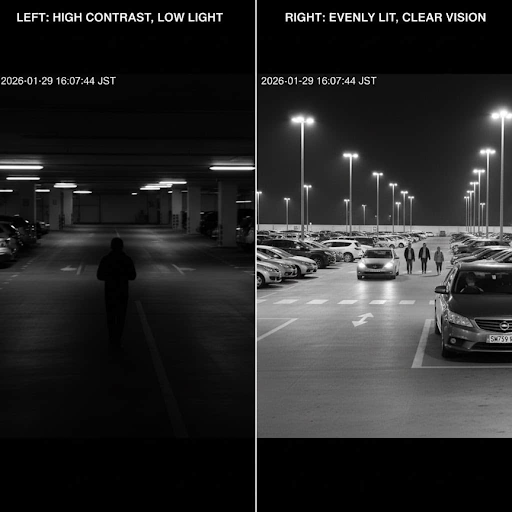
- The “Visual Camouflage” Effect: When a driver or pedestrian moves from a 50-lux hot spot into a 1-lux shadow, the human eye cannot adapt fast enough. The pupil constricts in the bright light, rendering the shadow areas absolute black to the brain. A pedestrian stepping out from between cars in a dark zone becomes invisible to a driver who was just blinded by the light under the pole.
- Security Camera Blindness: Modern security cameras struggle with high contrast. If the uniformity is poor, the camera’s shutter will expose for the bright spots, causing the dark areas to become “crushed blacks.” This means if a crime occurs in the shadow between two lights, the footage will likely be useless, creating a major liability for the property owner.
The Economic Penalty of “Brute Force” Lighting
Beyond safety, poor optics hit the project’s bottom line. When contractors realize their uniformity is poor (dark corners), their typical reaction is to use “Brute Force”—simply buying higher wattage fixtures to blast more light everywhere.
For example, to get the minimum 5 lux in the corner using a round lens, you might need to push the center brightness to 80 lux. That extra 75 lux in the center is essentially wasted energy. It doesn’t add value; it just burns electricity.
By fixing the distribution pattern first, you stop over-lighting the center. A precision optical system allows you to achieve the same safety standards with lower wattage fixtures. This means you can often replace a 200W generic fixture with a 150W optically optimized fixture, saving 25% on energy bills for the entire lifespan of the project.
The Solution—Rectangular Beams for Rectangular Spaces
How do we eliminate these hazards and costs? The solution lies in physics. Since parking spaces and driving lanes are rectangular, the light beam should be rectangular, not round.
We need an optic that can:
Stretch Wide: To cover the distance between poles (typically 3-4 times the mounting height).
Cut Short: To prevent backlight from spilling into neighboring windows.
Flatten the Curve: To distribute lumens evenly from the center to the edge.
Integrating the Asahi Solution
This specific challenge is why Asahi Optics developed the 2×2 80x60degree Optical Lens For Parking Lot Lighting.
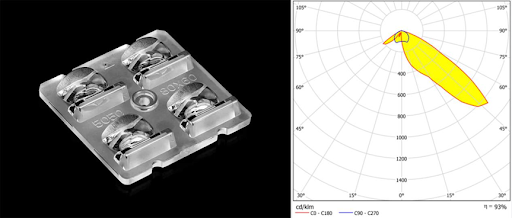
By using this dedicated 2×2 LED lens module, lighting designers can achieve a Max:Min ratio of 10:1 or better. This ensures cameras see clearly, drivers have full visibility, and property owners don’t pay for wasted electricity.
For more detailed strategies on layout planning, visit our guide on parking lot lighting applications.